
7 min read
What a Tenant Improvement Allowance Actually Covers — and What It Never Does
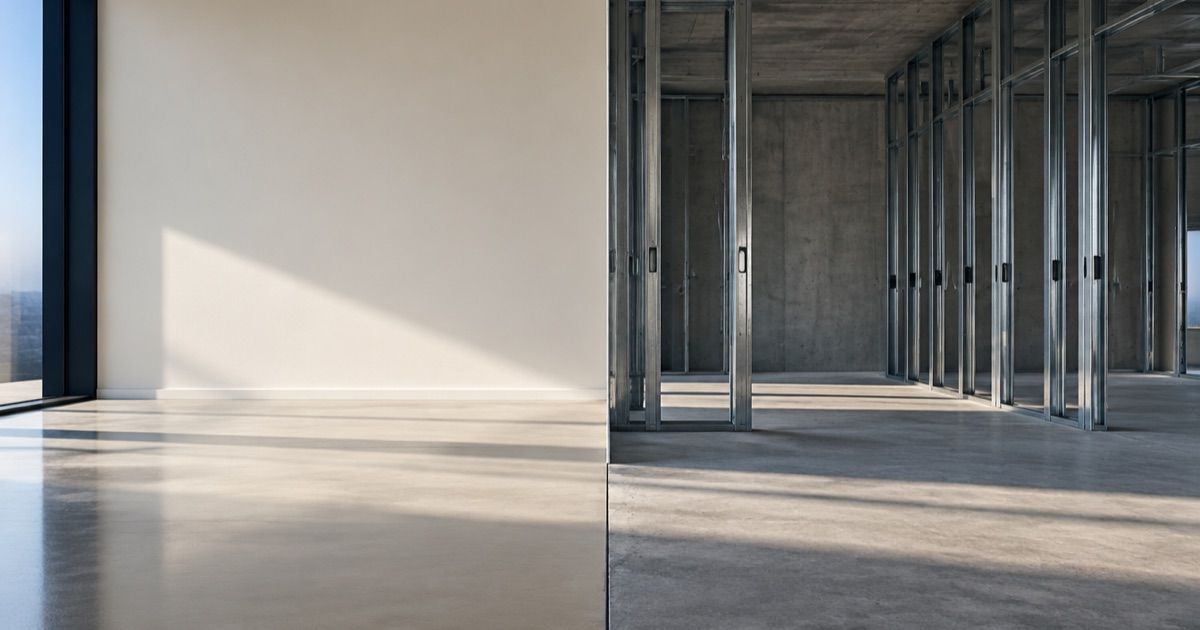
A tenant improvement allowance is money a landlord contributes toward building out your leased space. It typically covers permanent, built-in work that stays with the building — framing, electrical distribution, HVAC, flooring, doors and finishes — and it typically does not cover the things you would take with you, such as furniture, equipment and signage.
The part that surprises people is the gap. An allowance is a contribution, not a budget, and on most commercial build-outs it does not cover the full cost of the work. Knowing the size of that gap before you sign the lease is the difference between a project that starts on schedule and one that stalls while you find the difference.
Where the number comes from
Allowances are usually negotiated per square foot. Commercial real estate sources commonly report ranges from roughly $5 to $30 per square foot, with higher figures in prime office and retail locations, though the number moves with the market, the length of the lease and how badly the landlord wants the space filled.
Treat any published range as a starting point for negotiation rather than a quote. The allowance a landlord offers is driven by their economics — vacancy, lease term, your covenant strength — and has very little to do with what your specific scope of work actually costs to build.
What the allowance usually covers
Landlords fund what is known in the trade as hard costs: permanent improvements that remain part of the building when your lease ends.
- Interior framing, drywall and partitions
- Electrical distribution, panels and lighting
- HVAC distribution and ductwork
- Plumbing rough-in and restroom work
- Flooring, ceilings, doors and hardware
- Paint and standard finishes
The logic is simple from the landlord’s side. Every item on that list improves the asset and is still there for the next tenant, so it is an investment in their building rather than a gift to you.
What it almost never covers
The items below are commonly excluded, and they are usually the ones tenants forget to budget for:
- Furniture, fixtures and equipment. Desks, shelving, kitchen equipment, point-of-sale hardware.
- Moving and installation. Getting your operation from the old space into the new one.
- Data cabling and IT. Sometimes negotiable, often not.
- Exterior signage. Frequently a separate landlord approval as well as a separate cost.
- Specialty trade work unique to your use. Grease interceptors, walk-in coolers, compressed air, specialised ventilation.
That last category is where restaurant and specialty build-outs diverge sharply from office. Two spaces of identical square footage can carry very different costs once commercial kitchen equipment and ventilation enter the picture, and allowances rarely stretch to meet them.
Hard costs, soft costs, and the ones nobody budgets
Soft costs are the non-construction expenses a project still cannot proceed without: architectural and engineering drawings, permit and plan-check fees, and project management. Some leases allow a portion of the allowance to go toward soft costs; many do not, and the ones that do often cap it.
This matters more than it sounds. Design and permitting frequently run longer than the construction itself, and if the allowance cannot be spent on them, that money comes out of pocket months before a single wall goes up. Our answer on how long a tenant improvement takes covers the schedule side of the same problem.
How allowances get structured
Three structures come up repeatedly, and they are not equivalent:
- Straight allowance. The landlord reimburses up to a fixed amount, usually after the work is complete and lien releases are in hand. You finance the build in the meantime.
- Turnkey or build-to-suit. The landlord delivers the finished space to an agreed scope. Less flexibility, far less risk — but the scope definition is everything, because anything not written down is not included.
- Amortised allowance. The landlord funds more up front and recovers it through higher rent across the term. Useful when you are short on capital, expensive over a long lease.
Reimbursement timing is the detail that catches people out. A straight allowance paid on completion means you are funding the entire build-out yourself for the duration of the project.
Do this before you sign
The sequence that avoids nasty surprises is unintuitive, because it puts a contractor in the room before the lease is signed:
- Get your scope priced against the actual space, not against a per-square-foot rule of thumb.
- Compare that number to the allowance on offer, and treat the difference as a real line in your opening costs.
- Negotiate knowing the gap. An allowance that sounds generous can still leave a six-figure shortfall, and a modest one may be perfectly adequate for a light refresh.
- Confirm in writing what the allowance may be spent on, whether soft costs qualify, and when you get paid.
A landlord’s allowance is set before anyone has priced your scope. The only way to know whether it is enough is to have the work estimated — which is why it is worth doing while you still have negotiating leverage, rather than after the lease is executed.
Get the number before you negotiate
Wilson General Contracting has been building commercial space in Northern California since 1998, CSLB #798732, licensed, bonded and insured. We provide free, written, no-obligation estimates, so you can walk into a lease negotiation knowing what your build-out actually costs rather than hoping the allowance stretches.
If you are weighing a space in Tracy, Stockton, Modesto, the Bay Area or Sacramento, we can look at the scope with you. See our tenant improvement work, read what goes into commercial build-out costs, or request an estimate.